Understanding How Prescription Drug Pricing Really Works
You walk up to the pharmacy expecting a small copay… and instead hear:
“That will be $287.”
If that moment has ever caught you off guard—you’re not alone.
Prescription drug pricing is one of the most confusing parts of the healthcare system. And the truth is, the price you pay isn’t just about the medication—it’s about how your insurance processes it.
What Determines the Cost of Your Prescription?
Several layers influence what you pay at the pharmacy. Understanding these can help you avoid unexpected costs.
- Your Insurance Formulary (Drug List)
Every insurance plan has a formulary—a list of medications it covers.
Drugs are typically placed into tiers:
- Tier 1: Low-cost generics
- Tier 2: Preferred brand-name drugs
- Tier 3: Non-preferred brands (higher cost)
- Tier 4+: Specialty medications (highest cost)
👉 If your medication is not on the formulary, you may be responsible for the full retail price.
- Your Deductible and Coverage Phase
At the start of the year, many patients haven’t met their deductible yet.
That means:
- You may pay full price or a higher cost initially
- Costs often decrease after your deductible is met
For patients with Medicare Part D or similar plans, pricing can also change depending on your coverage phase.
- Pharmacy Benefit Managers (PBMs)
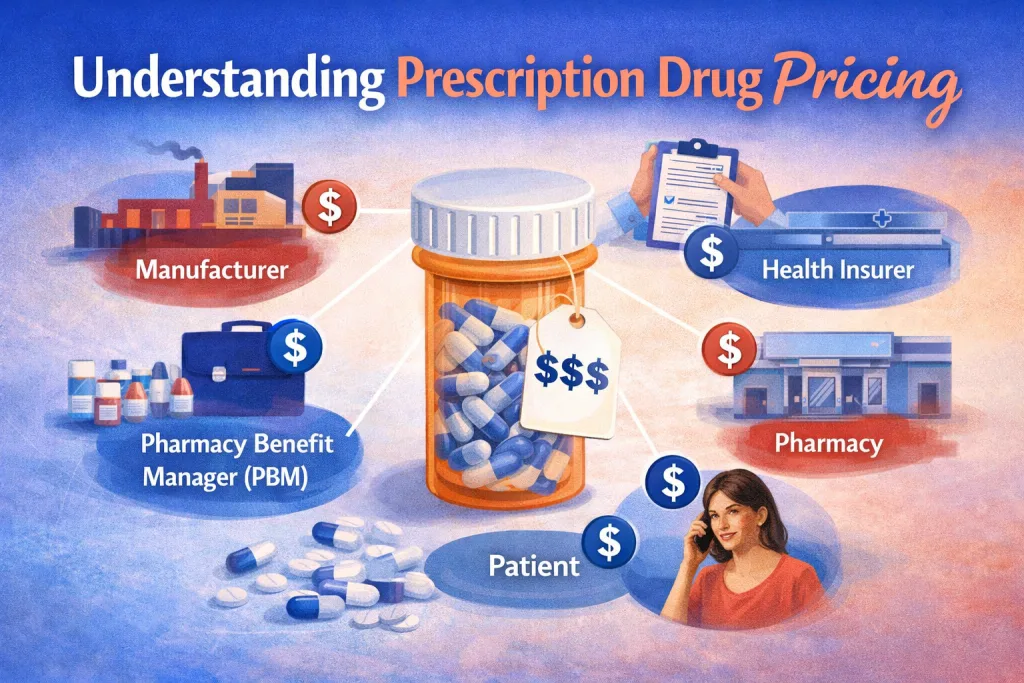
Behind the scenes, companies called Pharmacy Benefit Managers (PBMs) negotiate drug prices between:
- Insurance companies
- Drug manufacturers
- Pharmacies
These negotiations affect:
- Which drugs are covered
- What tier they fall into
- What price you ultimately pay
👉 This is why the same medication can cost different amounts depending on your insurance plan.
- Pharmacy Pricing Differences
Not all pharmacies charge the same price.
Even with insurance:
- One pharmacy may offer a lower negotiated rate
- Another may apply different pricing contracts
👉 It’s always worth asking or comparing prices.
- Manufacturer Coupons & Savings Programs
Some medications offer:
- Manufacturer coupons
- Discount programs
- Patient assistance programs
But there’s a catch:
- These may not apply if you’re using certain types of insurance (like Medicare)
A Real-Life Scenario
Let’s say two patients are prescribed the exact same medication.
Patient A:
- Medication is on formulary (Tier 1)
- Deductible already met
- Uses a preferred pharmacy
👉 Pays: $15
Patient B:
- Medication not on formulary
- Deductible not met
- No savings program applied
👉 Pays: $300
Same medication. Completely different outcome.
Why Prices Can Change Suddenly
Patients often ask:
“Why was this $20 last month and now it’s $200?”
Here are common reasons:
- You moved into a new coverage phase
- Your deductible reset at the start of the year
- The drug changed tiers on your formulary
- A manufacturer coupon expired
- Pharmacy pricing contracts changed
3 Smart Tips to Lower Your Prescription Costs
✔ Ask if your medication is on your plan’s formulary
✔ Request a generic or alternative if cost is high
✔ Check multiple pharmacies or ask about savings programs
When to Ask for Help
If a prescription feels unusually expensive:
- Don’t assume the price is final
- Don’t leave without asking questions
Sometimes a simple change—like a different pharmacy or medication—can significantly reduce your cost.
How Patient Advocacy Makes a Difference
At Stepping Stone Advocacy Services, we help patients and families:
- Understand why a medication costs what it does
- Navigate insurance requirements and formularies
- Identify lower-cost alternatives or solutions
- Coordinate with providers when coverage issues arise
Because no one should have to choose between their health and their finances.
Final Thought
Prescription pricing isn’t random—it’s structured, layered, and often misunderstood.
But when you understand how it works, you gain something powerful:
👉 The ability to ask the right questions, explore better options, and take control of your healthcare costs.